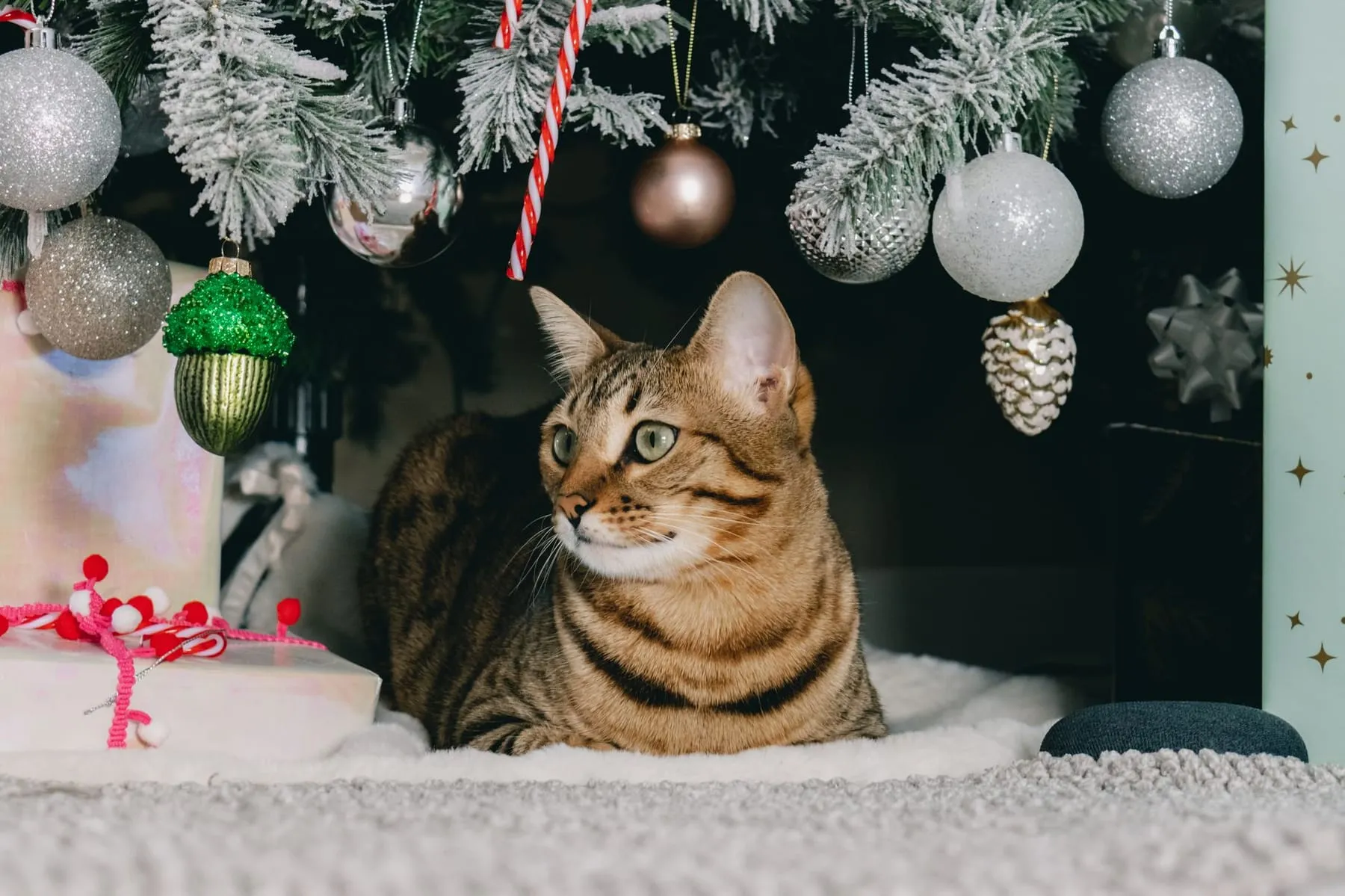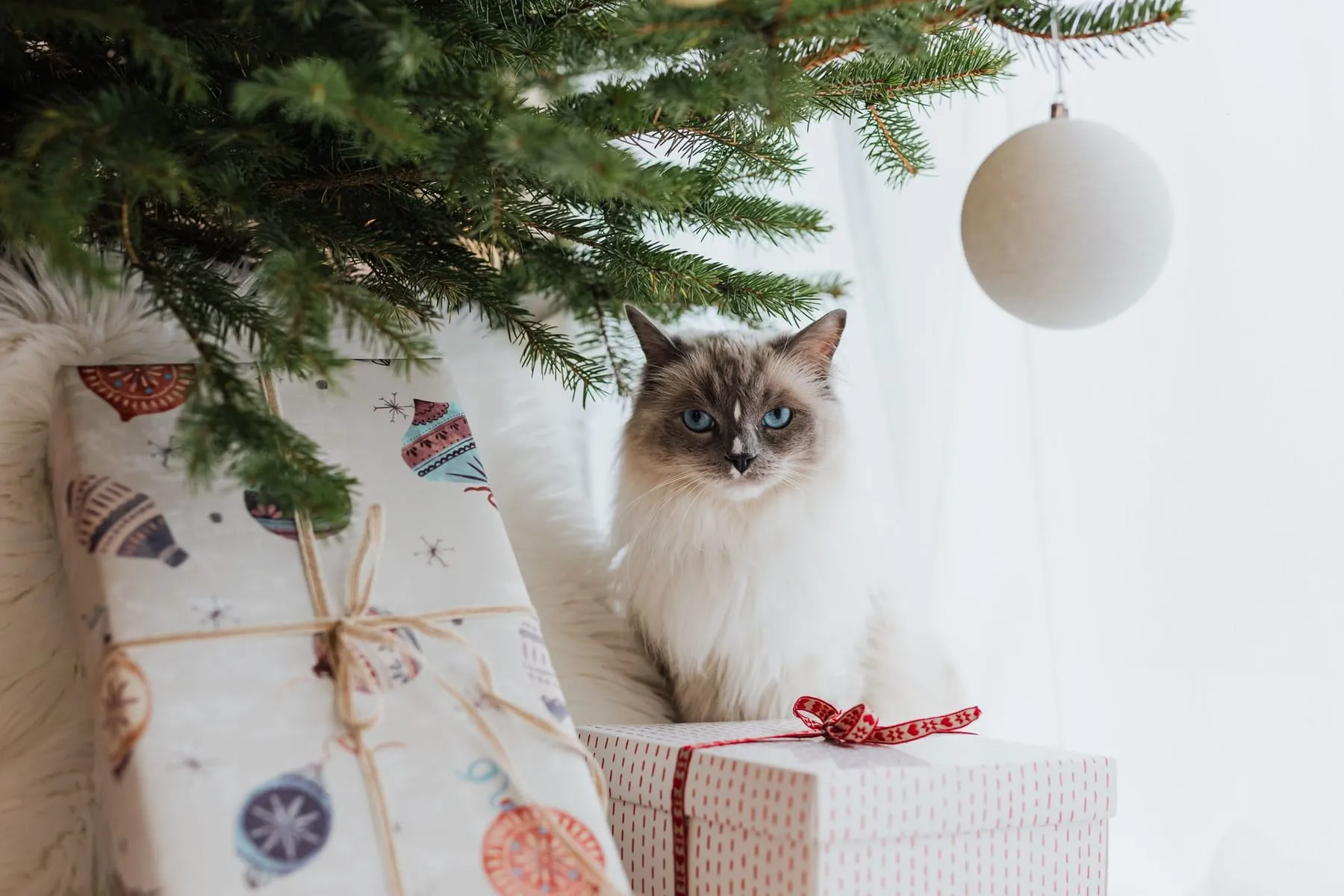
Real Christmas trees are not highly poisonous to cats, but they are not harmless either. The tree itself is usually a mild risk, and most cats that chew a few needles get no worse than an upset stomach.
The real dangers sit around the tree: sharp needles that can lodge in the mouth or gut, tree water that collects bacteria and chemicals, and decorations such as tinsel and lilies that can be far more serious than any branch. Knowing which is which helps you choose a tree and set it up so your cat can enjoy Christmas safely.
Are Christmas trees toxic to cats?
Christmas trees are mildly toxic to cats rather than seriously poisonous. The firs, spruces and pines sold as Christmas trees contain oils and resins that can irritate a cat’s mouth and stomach if chewed or swallowed.
Typical effects of a cat eating a small amount of needles are drooling, pawing at the mouth, vomiting or a short bout of diarrhoea. These usually pass on their own. Larger amounts, or a cat that drinks sap or concentrated oil, can cause more serious problems, and in rare cases the liver or kidneys can be affected.
Cats are more sensitive to plant oils than dogs or people, because their livers are less able to break down certain compounds. This is why vets warn against pine and fir essential oils in the home, even though a real tree in the corner of the room is normally fine.
Which Christmas trees are safest for cats?
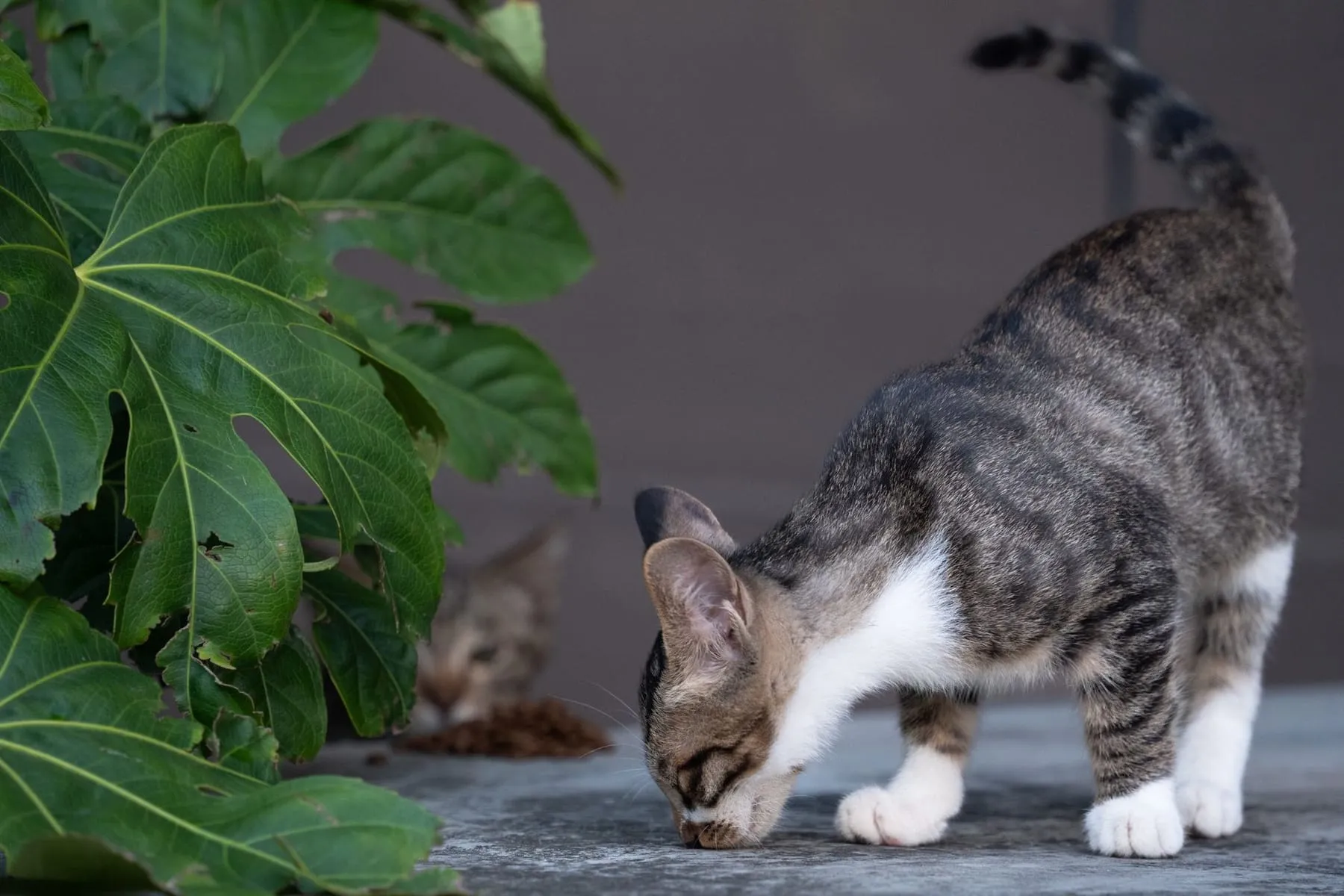
Firs and spruces are usually considered the safer choices for a home with cats, and pines the ones to be most careful with. Sources do not all agree on how much difference the species makes, so treat every real tree as something your cat should not eat.
| Tree | Risk for cats | Why |
|---|---|---|
| Nordmann fir | Lower | Soft, flat needles that stay on the tree, so fewer end up on the floor |
| Fraser fir | Lower | Soft needles and good needle hold |
| Noble fir | Lower | Firm needles but holds them well |
| Norway spruce | Lower to moderate | Mildly irritating, but needles are sharp and drop quickly in a warm room |
| Blue spruce | Lower to moderate | Very sharp, stiff needles that can injure a mouth or paw |
| Pines (e.g. Scots pine) | Moderate | More resinous oils, which many vets regard as a greater concern for cats |
For most cat owners, a Nordmann fir is the sensible pick. It is the UK’s most popular Christmas tree, its needles are soft, and it is one of the Christmas trees that don’t drop needles much, which matters because loose needles on the carpet are what most cats end up eating. You can read more about each type in our guide to what trees are Christmas trees.
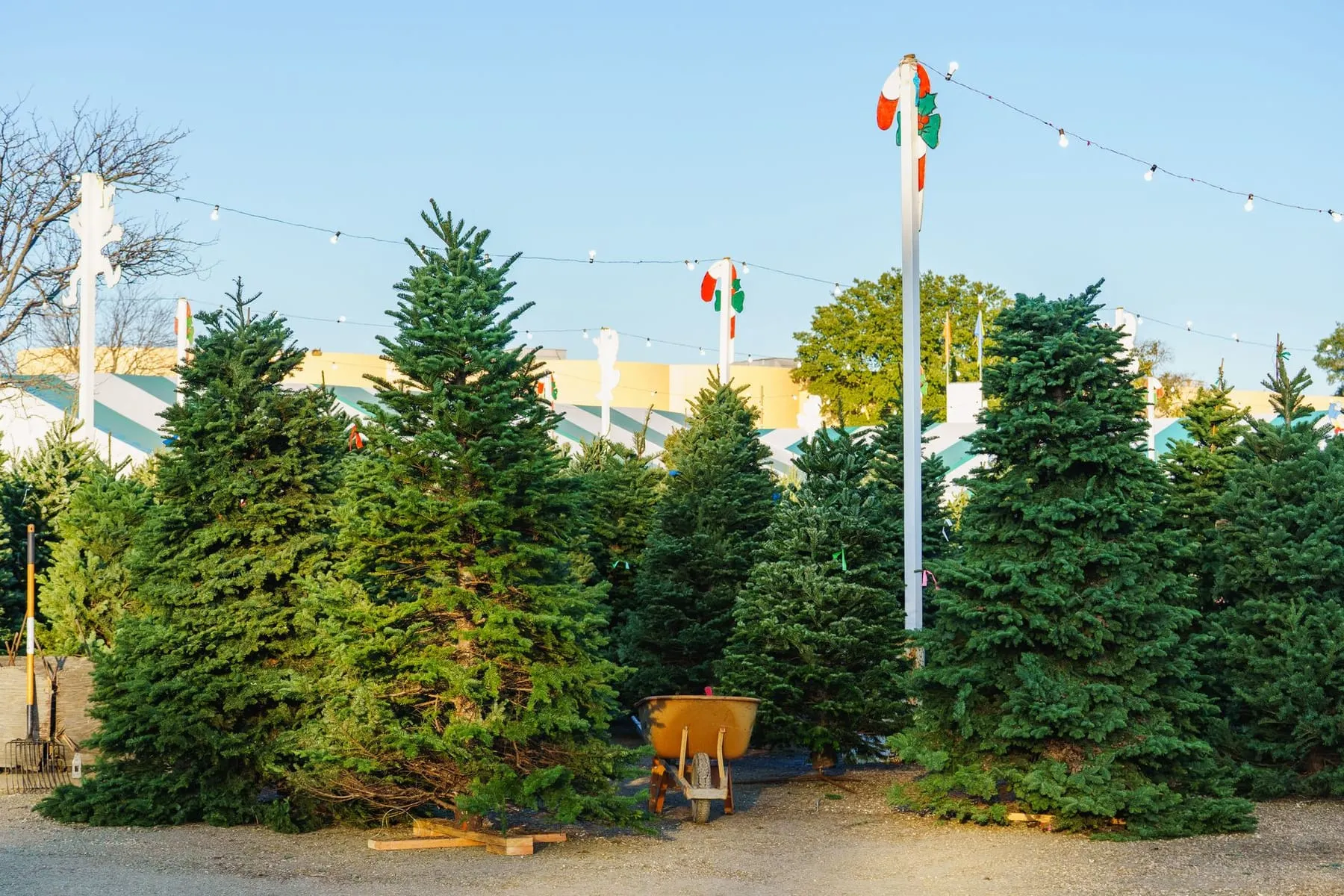
Choosing your tree at a farm also helps, because a freshly cut tree holds its needles far longer than one cut weeks earlier. You can find a Christmas tree farm near you and ask staff which of their trees has the best needle hold.
What parts of a real Christmas tree can harm a cat?
The parts of a real tree most likely to harm a cat are the needles, the sap and the water in the stand.
- Needles. Even on a low toxicity tree, needles are a physical hazard. Sharp ones can stick in the gums, throat or the soft palate, and swallowed needles can irritate or, rarely, injure the stomach and intestines. They can also catch in eyes and paws.
- Sap and oils. Sticky sap on fur can be swallowed during grooming. Small amounts usually cause mild stomach upset, but larger amounts are more serious.
- Tree water. Cats love drinking from unusual places, and the stand is a tempting bowl. Water left standing for days grows bacteria that can upset the stomach. Never add fertiliser, aspirin, sugar, bleach or shop bought preservatives to tree water if you have pets. Plain water is all a tree needs, as our guide on how to keep a Christmas tree alive explains.
- The tree itself falling. A cat climbing the trunk can bring down a badly anchored tree, which is a bigger injury risk than anything it eats.
Cover the stand with a tree skirt, a fitted cover or a piece of netting, and keep a bowl of fresh water elsewhere so your cat is less tempted.
Which Christmas decorations and plants are more dangerous than the tree?
Several Christmas decorations and plants are more dangerous to cats than the tree itself. These are the ones vets see most often over the festive period.
- Lilies. All parts of a lily, including the pollen and the water in the vase, are extremely toxic to cats and can cause kidney failure. Lilies often appear in Christmas bouquets. The safest approach is to keep them out of a home with cats entirely.
- Tinsel, ribbon and string. Not poisonous, but if swallowed they can tangle in the gut and cause a life threatening blockage that may need surgery. Cats find tinsel irresistible, so leave it off the tree.
- Baubles. Glass baubles shatter and cut paws and mouths. Small baubles and their metal hooks can be swallowed.
- Lights and cables. Chewed cables can cause burns or electric shocks. Low voltage LED sets with tidy, tucked away cables are the safer choice, and our guide to the best Christmas tree lights covers what to look for.
- Edible and homemade decorations. Chocolate is toxic to cats as well as dogs, although cats eat it less often. Salt dough ornaments contain a lot of salt and can cause salt poisoning if chewed.
- Other festive plants. Poinsettia, holly, mistletoe and ivy can all cause drooling, vomiting or diarrhoea. Poinsettia is usually only mildly irritating, but holly berries and mistletoe are best kept well out of reach.
- Scented products. Pine and fir essential oils, reed diffusers and scent sprays are much more concentrated than a real tree and can be dangerous for cats.
What are the symptoms, and when should you call a vet?
Call your vet if your cat has eaten any part of the Christmas tree and shows signs of being unwell, or straight away if it may have swallowed tinsel, ribbon, a bauble, lilies or tree water with additives in it. For those, do not wait for symptoms.
Signs that a cat has eaten something it should not include:
- drooling or pawing at the mouth
- vomiting or retching
- diarrhoea
- not eating, or showing interest in food then walking away
- lethargy or hiding
- a tender or swollen tummy
- straining in the litter tray or not passing faeces
- unusual breathing, wobbliness or twitching
A single bout of vomiting after nibbling a needle or two, in a cat that is otherwise bright and eating, often settles by itself. Keep an eye on your cat and ring the vet if it vomits repeatedly, stops eating, seems lethargic or you are simply worried. Vets would much rather hear from you early.
Check your practice’s out of hours arrangements before Christmas, as many surgeries close over the bank holidays and hand emergencies to a separate service. If you go in, take a photo of what your cat ate, or a sample of it.
Is an artificial Christmas tree safer for cats?
An artificial tree removes the sap, oils and tree water, but it is not risk free. Cats can chew and swallow the plastic needles, which can cause stomach upsets or blockages, and artificial trees can also topple if climbed.
For most households, a well chosen real tree is perfectly reasonable with a cat. A Nordmann or Fraser fir, a covered stand with plain water, regular hoovering of dropped needles and sensible decorations take care of most of the risk. The bigger factor is your cat’s personality: a calm older cat may ignore the tree entirely, while a young kitten may treat it as a climbing frame.
If your cat is especially determined, our guide on how to keep cats away from your Christmas tree has practical ways to anchor the tree, deter climbing and give your cat something better to do.
Questions people ask
Is a Nordmann fir safe for cats?
A Nordmann fir is one of the better choices for a home with cats. Its needles are soft and stay on the branches well, so there is less to chew, though it is still mildly irritating if eaten.
Can the smell of a Christmas tree hurt a cat?
The natural scent of a real tree in a room is not considered harmful to cats. The problem is concentrated pine or fir essential oils, so avoid scent sprays and diffusers, which can be dangerous to cats.
Are pine cones poisonous to cats?
Plain pine cones are not usually poisonous, but they can cause a blockage if a cat chews and swallows pieces. Cones sprayed with glitter, paint or scent are best kept out of reach.
Is it normal for my cat to eat Christmas tree needles?
Many cats will nibble a new plant out of curiosity, but it is not good for them. If your cat keeps chewing the tree, move it out of reach or close the door, and speak to your vet if it starts vomiting.
Are potted Christmas trees safer for cats?
A potted tree carries the same needle and sap risks as a cut one, but there is no stand of stagnant water to drink. Check the compost has no added fertiliser pellets a cat could eat.