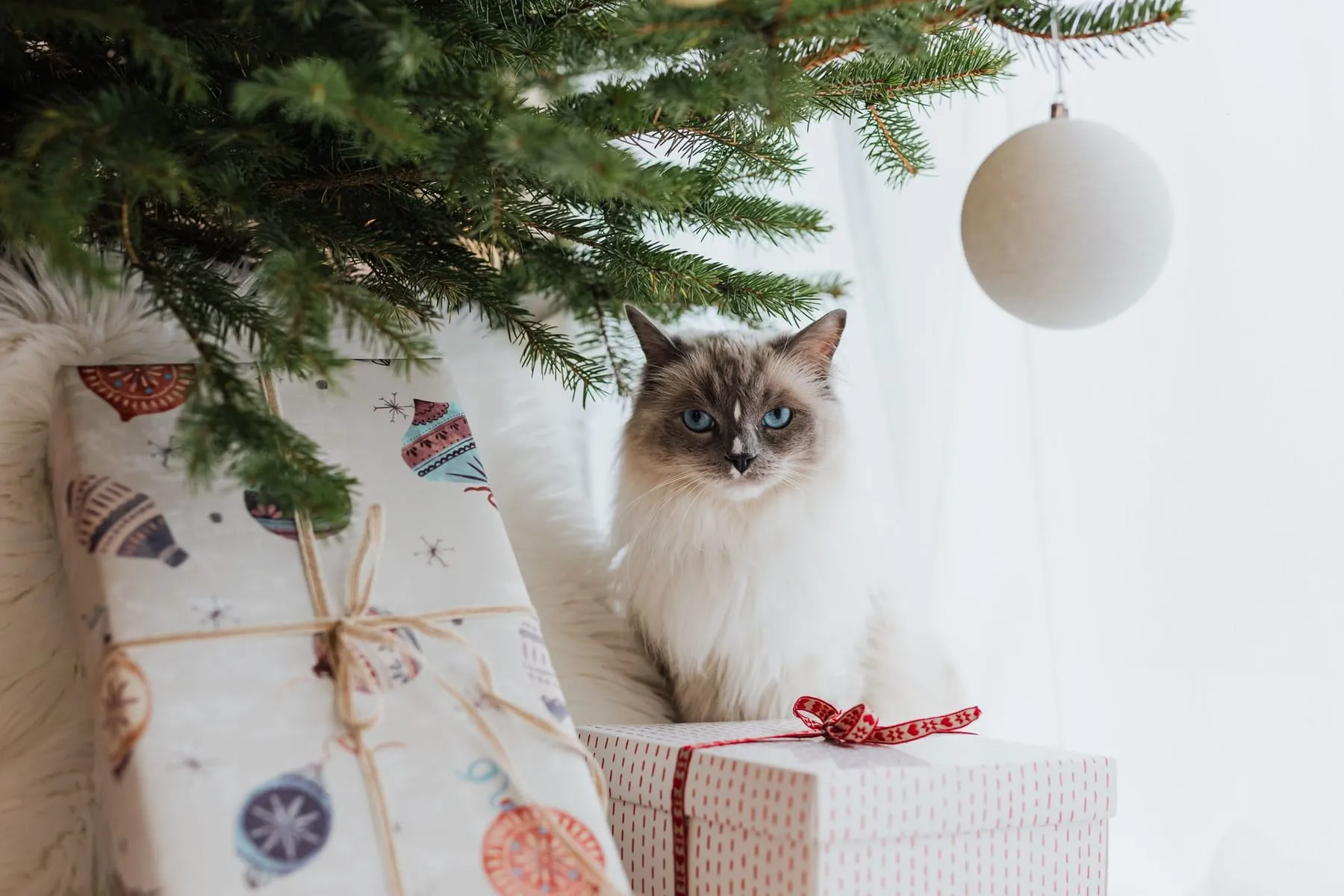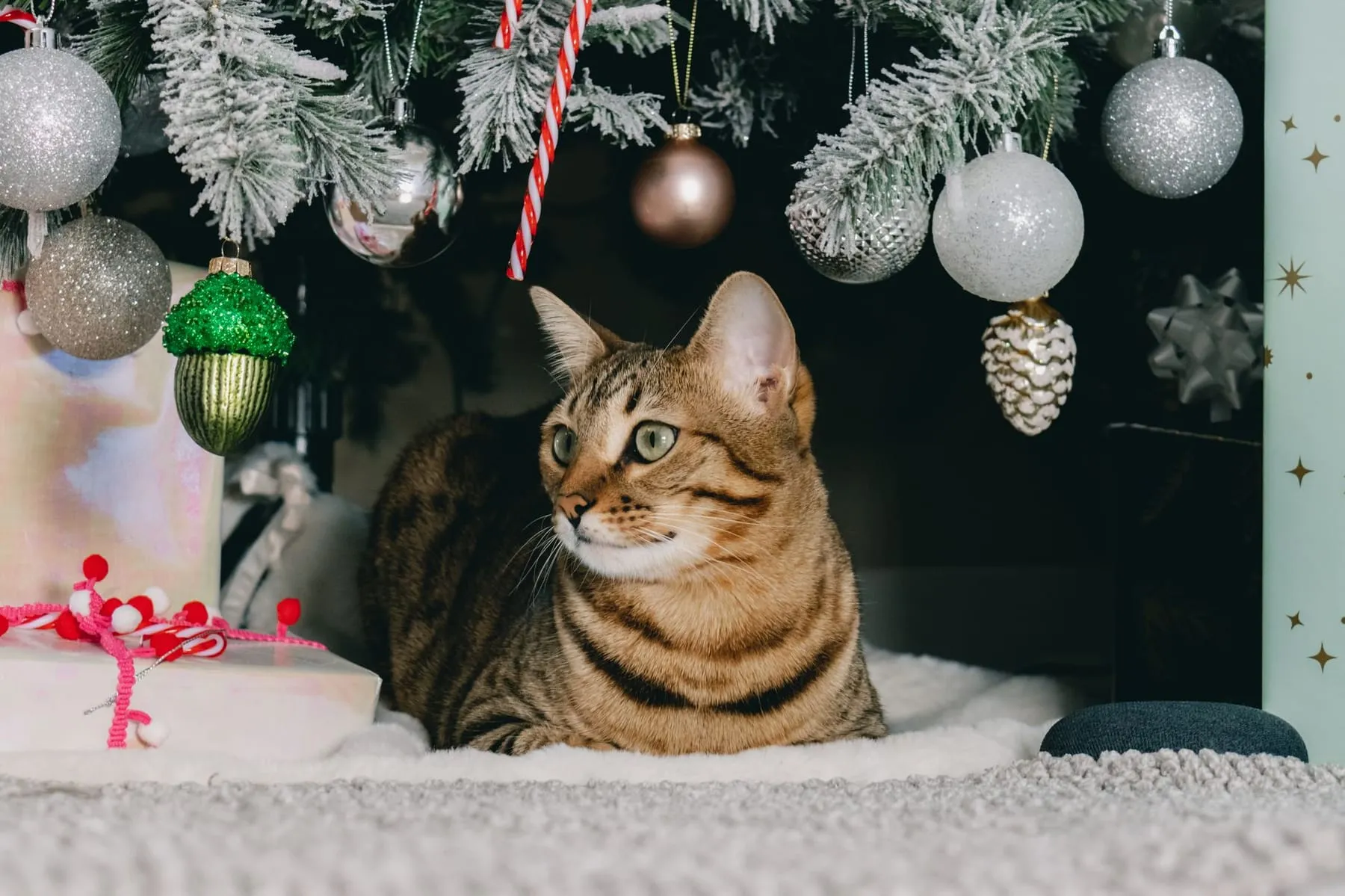
To most cats, a Christmas tree is a new climbing frame that smells of outdoors and comes with dangling toys. That is why so many owners find baubles under the sofa and the tree leaning at an angle by Boxing Day.
The good news is that a few changes make a tree far less tempting and much harder to pull over. None of them involve shouting at your cat, and most cost almost nothing.
How do you keep a cat away from a Christmas tree?
The most effective way to keep a cat away from a Christmas tree is to combine three things: make the tree stable, make it boring, and make the area around it unpleasant to walk on. A single trick rarely works on its own, but together they put off most cats.
In practice that means:
- anchoring the tree so it cannot fall, even if your cat climbs it
- placing it away from sofas, shelves and windowsills your cat could launch from
- covering the base with a texture cats dislike
- leaving the bottom branches bare and skipping tinsel
- covering the water in the stand
- giving your cat somewhere more interesting to climb
- closing the door when nobody is around
It also helps to know which parts of a tree are a health risk if your cat does get to it. Our guide to which Christmas trees are toxic to cats covers needles, sap, water and decorations in detail.
Choose the right tree and the right spot
A smaller, soft needled tree in a corner away from furniture is the easiest set up for a cat household. Where you put the tree matters as much as what you put on it.
Pick a tree that holds its needles. Loose needles on the floor are what most cats end up chewing. A Nordmann or Fraser fir keeps its needles far better than a Norway spruce, and freshly cut trees hold them longer still. Our guide to Christmas trees that don’t drop needles compares the main types. Buying direct from a farm means you can see exactly how fresh the tree is, and you can search for a Christmas tree farm near you.
Think about size. A 5 to 6 ft tree is easier to secure than a tall one, and a lighter tree does less damage if it does come down.
Leave a gap. Keep the tree at least a cat’s leap away from sofa backs, bookcases and windowsills. Cats rarely climb from the trunk up; they jump into the branches from something nearby.
Use a room with a door if you can, so you can shut the cat out overnight and when you go out.

How to stop a cat knocking over the Christmas tree
To stop a cat knocking over the Christmas tree, use a heavy, wide stand and tie the tree to something fixed. A falling tree can injure a cat, smash decorations and break lights, so this is the most important step.
- Use a sturdy stand. A wide, heavy metal stand with a deep water bowl and good screws grips the trunk far better than a lightweight plastic one. Check the trunk is straight and tight before you decorate.
- Tie it back. Loop clear fishing line or thin garden wire around the trunk about two thirds of the way up and fix it to a screw or hook in the wall or window frame behind. It is barely visible and stops the tree tipping even if your cat reaches the top.
- Weigh down the base. If your stand is light, bricks or a heavy planter around it, hidden under a tree skirt, add stability.
Check the ties every few days, as cut trees settle a little as they drink.

Which deterrents keep cats off a Christmas tree?
Textures and smells that cats dislike are the safest deterrents. Use them around the base and lower trunk, where your cat starts its approach.
- Kitchen foil. Wrapped around the base of the stand or laid on the floor around it. Many cats dislike how it feels and sounds.
- Double sided tape. Stuck on the edge of the stand or on a board around the base. Cats hate sticky paws.
- Plastic deterrent mats. Flexible mats with blunt plastic nubs, sold for gardens and kitchen worktops, can be laid around the tree under a skirt.
- Citrus peel. Fresh orange or lemon peel around the base puts off some cats. Never use citrus or pine essential oils, sprays or diffusers, as concentrated oils can be harmful to cats.
- A low barrier. A pet gate, a child’s playpen or a ring of furniture around the tree works well for kittens and very persistent climbers.
Avoid spraying your cat with water or shouting. It tends to make cats nervous of you rather than the tree, and they simply wait until you leave the room.
Just as useful is giving your cat a better option. A cat tree or shelf near a window, a new box, or ten minutes of play with a wand toy each evening uses up the energy that would otherwise go into climbing.
How to decorate a Christmas tree when you have a cat
Decorate a cat household tree from the middle upwards, with unbreakable decorations fixed on firmly. Our main guide on how to decorate a Christmas tree covers styling; these are the cat specific changes.
- Wait a day or two. Put the tree up bare and let your cat sniff it and lose interest before anything dangly goes on.
- Keep the bottom third bare, or use only large, plain decorations there. Anything swinging at paw height is an invitation.
- Choose shatterproof baubles in plastic, wood, felt or fabric, and save glass and sentimental pieces for high branches or another room.
- Fix decorations firmly. Close metal hooks with pliers so they cannot drop off, or tie decorations on tightly.
- Skip tinsel, ribbon and string, which can cause serious blockages if swallowed.
- Avoid edible decorations such as chocolates and salt dough ornaments.
For lights, wind them close to the trunk and inner branches rather than draping them on the tips, and run the cable down the back of the tree and along the wall. A cable protector or cord cover stops chewing. Our guide on how to put lights on a Christmas tree shows the wrapping method, and switching off at the plug when you go out or to bed is a good habit.

Cover the water and keep the floor clear
Cover the tree stand so your cat cannot drink from it. Tree water goes stale quickly, and a cat drinking from it can get an upset stomach.
A tree skirt, a fitted stand cover or a piece of netting or card cut to fit around the trunk all work. Use plain tap water only, with no feed or additives, and top it up daily. A fresh tree in a warm room can drink a lot, and our guide on how to keep a Christmas tree alive explains how much.
Hoover dropped needles every day or two so there is nothing on the floor to chew, and put fresh water bowls elsewhere in the house so the stand is less interesting.
If your cat still keeps going for the tree after all this, the simplest answer is to close the door when you are not in the room. Most cats lose interest within a week, and by the time the tree comes down they have usually forgotten it was ever exciting. If your cat chews the tree and is sick more than once, stops eating or seems unwell, ring your vet.
Questions people ask
What smell keeps cats away from a Christmas tree?
Many cats dislike citrus, so fresh orange or lemon peel tucked around the base can help. Do not use citrus or other essential oils, sprays or diffusers, as concentrated oils can be harmful to cats.
Does foil really keep cats off a Christmas tree?
Kitchen foil around the base or trunk puts off a lot of cats because they dislike the feel and sound under their paws. It works best combined with other steps, and some confident cats get used to it within days.
Should I use a water spray bottle to stop my cat climbing the tree?
It is better not to. Spraying a cat tends to make it wary of you rather than the tree, and it often just learns to climb when you are out of the room.
Will my cat get bored of the Christmas tree?
Many cats lose interest after the first few days once the tree stops being new. Putting the tree up undecorated for a day or two lets that curiosity wear off before the baubles go on.
Is a small tabletop tree better if I have a kitten?
A small tree on a sturdy surface the kitten cannot reach, or in a room you can close off, is often the easiest option for a first Christmas with a kitten. Make sure it cannot be knocked off the edge.